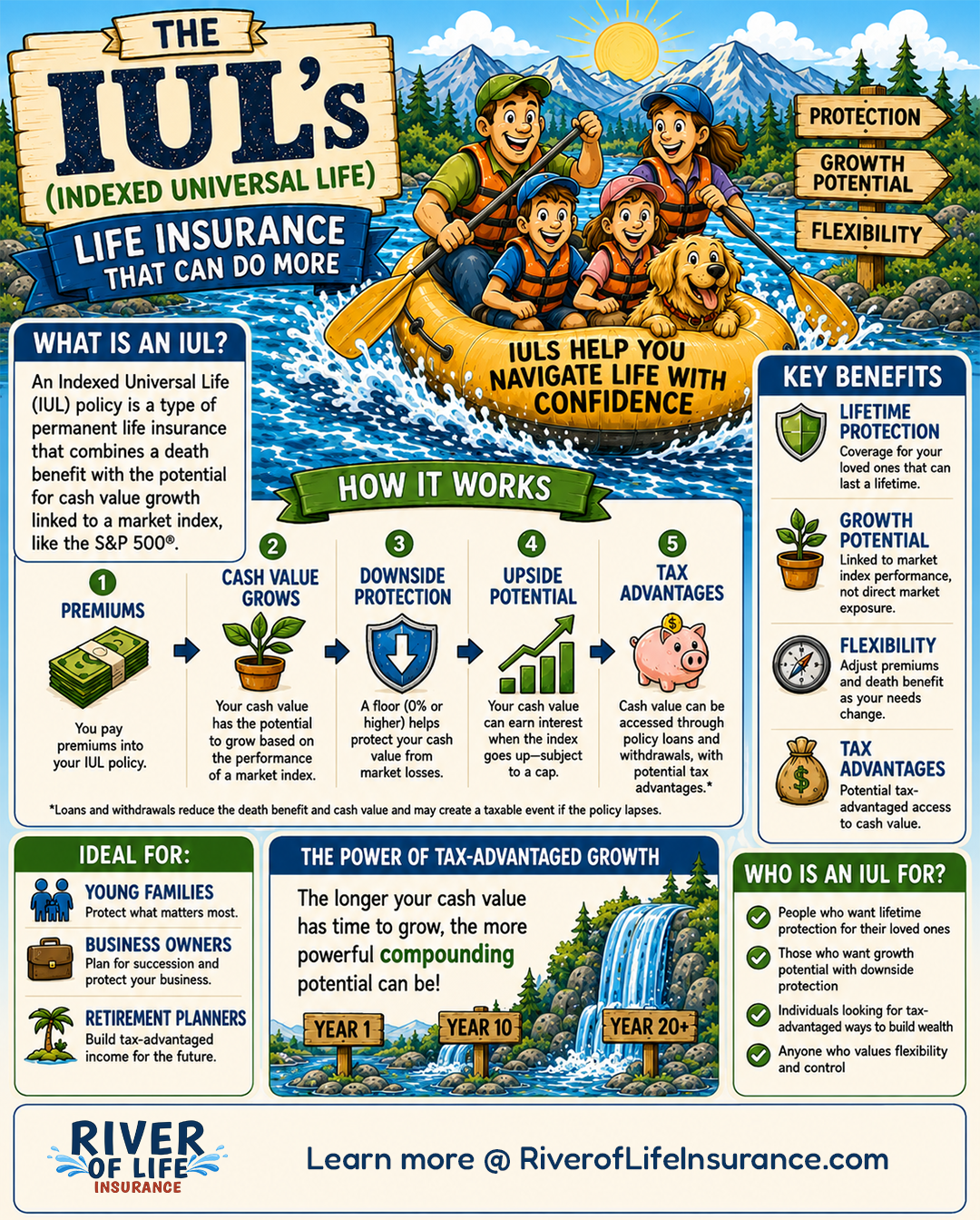
An IUL does not generally invest the policy owner’s cash value directly in a stock market index. Instead, the insurer uses index performance as part of a formula for calculating interest credits.
A participation rate determines how much of measured index performance participates in the calculation.
A cap may place an upper limit on the amount of index-linked interest credited for a period.
A spread may be deducted from index performance before interest is credited.
A floor may establish the minimum indexed credit, often 0% for certain strategies.
These terms can materially affect results and may change within contractual limits.
Two IUL policies referencing the same index can therefore perform differently. Illustrations demonstrate hypothetical results using assumptions; they are not guarantees of future crediting.
Start With the Financial Need
The most useful way to evaluate this topic is to begin with the financial problem rather than a product label. Identify who or what needs protection, how long the need is expected to last, what resources already exist, and what would happen if no additional planning were put in place. That framework makes it easier to separate necessary protection from optional features and to choose a solution that remains affordable over time.
What Could Make This Strategy Work Well?
The strategy is more likely to fit when the underlying need is clear and the financial assumptions are realistic. Important elements include policy charges and how they may change with age, how loans and withdrawals affect policy sustainability, and the difference between illustrated values and guaranteed values. The plan should also leave room for the relationship between premium funding and the death benefit and current and contractual limits on caps, participation rates, and spreads rather than assuming life will unfold exactly as projected.
Affordability matters as much as design. A policy that looks excellent on an illustration but requires a premium the owner cannot comfortably maintain may be a poor fit. The same is true of a strategy that ties up money needed for emergencies or forces someone to take more risk elsewhere just to keep the policy in force.
Common Mistakes to Avoid
Borrowing aggressively without stress-testing the policy. This can create a mismatch between what the owner expects and what the policy or strategy actually provides.
Comparing iul directly with a market investment without accounting for insurance costs. The contract language and long-term economics matter more than a simplified label.
Assuming a 0% indexed floor means policy value cannot decline. Liquidity, taxes, guarantees, and opportunity cost should be considered before committing money.
Treating illustrated crediting rates as promised returns. A strategy should be reviewed when the assumptions behind it materially change.
Funding only the minimum when the goal is cash accumulation. The right tool is the one that solves the defined problem without creating a larger one elsewhere in the plan.
A Practical Decision Checklist
Before acting, be able to answer the following in plain language:
How often will the policy be reviewed after issue?
What is guaranteed and what is only illustrated?
How does the policy perform under lower crediting assumptions?
How much premium is planned and why?
What are the current cap, participation-rate, spread, and loan terms?
The objective is not to memorize product terminology. It is to understand the financial consequences well enough to know what you are agreeing to and why.
When to Review This Part of the Plan
This topic deserves another look whenever the assumptions behind the original decision change. Useful review triggers include a planned premium change, a large loan or withdrawal, a change in crediting terms, a retirement-income decision, or a policy review showing performance materially different from the original illustration. A review does not automatically mean a policy should be replaced or a strategy should be changed. It is simply a checkpoint to confirm that the original need still exists, the contract is behaving as expected, and the current plan still fits the household or business. If a replacement is being considered, compare the existing and proposed coverage carefully before giving up benefits, guarantees, pricing, or rights that may be difficult to recreate later.
Bottom Line
The best answer is the one that fits the actual financial objective, remains affordable, and is understood well enough to manage over time. Review the policy contract rather than relying only on marketing language, and distinguish guaranteed provisions from projections or assumptions. When tax, legal, estate, investment, or complex business issues are involved, general education should be paired with advice from the appropriately qualified professional.